OSHA stands for the Occupational Safety and Health Administration, and it plays a vital role in keeping workplaces safe, especially in industries like construction, manufacturing, and healthcare.
Created in 1970, OSHA’s mission is to ensure that workers return home safely each day. They establish safety regulations, inspect job sites, and hold employers accountable when safety is compromised. Think of OSHA as the watchdog that helps prevent accidents, injuries, and fatalities on the job.
In 2022, the Bureau of Labor Statistics (BLS) recorded over 2.8 million nonfatal workplace injuries and illnesses, many linked to poor visibility, slips, and falls.
Whether it’s requiring hard hats, machine guards, or proper chemical storage, OSHA ensures that safety isn’t just a suggestion; it’s the law.
What Are OSHA Lighting Standards?
Let’s talk about lighting. OSHA doesn’t just focus on helmets and harnesses; it also cares about how well workers can see on the job. Poor lighting can lead to serious accidents, including slips, trips, or the misuse of tools.
According to a study by the Illuminating Engineering Society (IES), improving workplace lighting can reduce accident rates by up to 60%, especially in industrial environments.
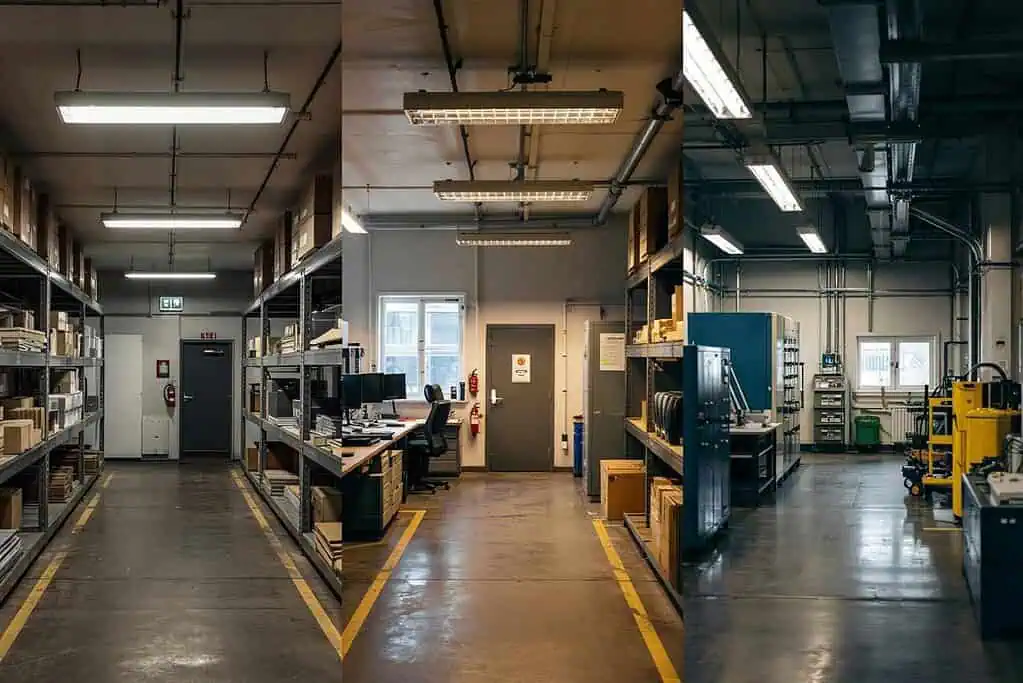
OSHA has specific lighting standards for different work environments. These standards are measured in foot-candles, a unit that indicates how much light illuminates a one-square-foot area from one foot away. The rule is simple: the more detailed or hazardous the task, the brighter the required lighting.
For Example:
- 5 foot-candles – basic areas like hallways or storage rooms
- 10 foot-candles – general workspaces for routine tasks
- 30 foot-candles – precision areas like mechanical rooms or labs
The goal? To reduce eye strain, improve visibility, and keep workers safe.
OSHA Rules on Lighting: What You Need to Know
OSHA’s lighting regulations are legally binding and found in two key standards:
- 29 CFR Part 1910 – General Industry Standards
- 29 CFR Part 1926 – Construction Industry Standards
For instance, 29 CFR 1910.37(b) requires exit routes to be lit so employees can evacuate safely. 1926 Subpart D outlines lighting levels for construction zones, tunnels, and confined spaces.
In 2023, OSHA issued more than 1,500 lighting-related citations, with average penalties ranging from $2,000 to $13,000 per violation.
Why does this matter? Inadequate lighting can lead to injuries and improper equipment use. On the flip side, proper lighting enhances both safety and productivity.
What OSHA Considers Adequate Lighting:
- Construction: 5 foot-candles in general zones; 10–30 in hazardous areas
- General Industry: Varies by task, offices need moderate lighting, labs need more
OSHA Lighting Guidelines by Work Area
Lighting needs change depending on where you’re working, and OSHA knows that. A dim storage room doesn’t need the same brightness as a first aid station or a construction site. That’s why OSHA provides specific lighting recommendations for different workspaces, measured in foot-candles.
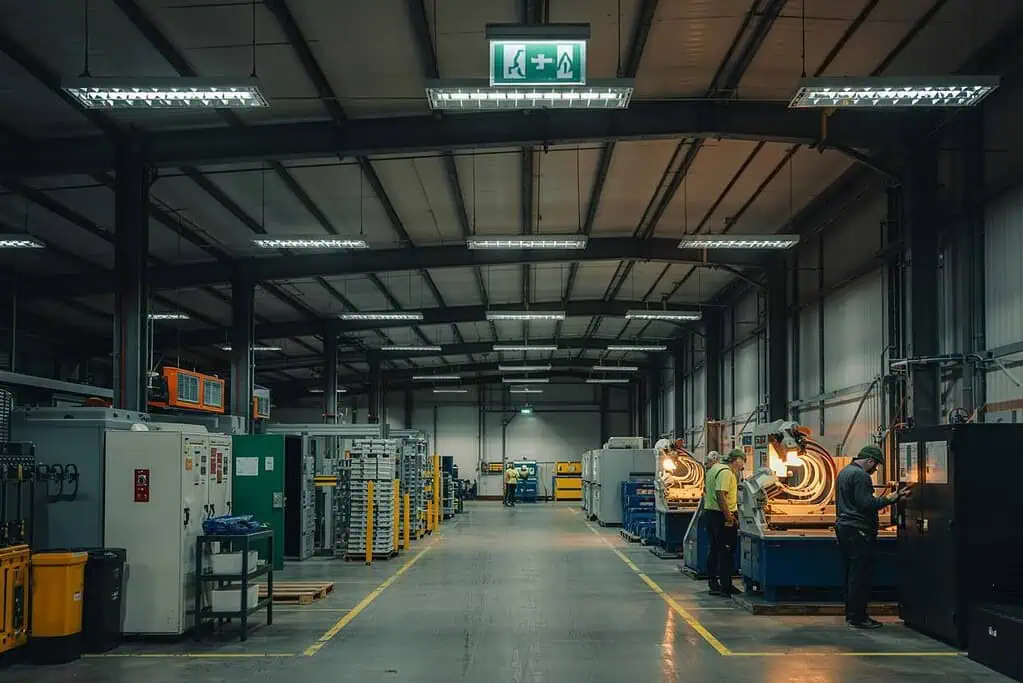
Here’s How the Guidelines Break Down by Area:
- Warehouses and Storage Areas
These spots don’t need to be super bright, but people still need to see well enough to move around safely. OSHA typically requires five foot-candles here. - Mechanical/Electrical Rooms
These rooms often involve detailed work with wiring, machinery, or control panels. OSHA recommends at least 20 foot-candles, sometimes more, so workers don’t make dangerous mistakes. - Construction Zones
On active job sites, lighting is crucial, especially in areas like tunnels, shafts, or confined spaces. OSHA sets a baseline of 5 foot-candles in general zones, and 10–30 foot-candles in more hazardous or detailed work areas. - First Aid and Medical Areas
These areas must be well-lit for obvious reasons. OSHA calls for a minimum of 30 foot-candles here. - Office and Administrative Spaces
OSHA expects around 30 foot-candles in offices to reduce eye strain and keep productivity up.
Industrial Lighting Standards OSHA Enforces
When it comes to manufacturing, assembly lines, and heavy-duty zones, OSHA doesn’t play around. In these areas, precision, moving parts, and high-risk equipment are ubiquitous, making lighting more than just a safety feature – it’s a lifeline.
In industrial settings, OSHA generally expects 30 foot-candles or more, depending on the task.
Real-World Example? An auto parts plant was cited for poor lighting conditions in the paint booth area. One employee tripped over a hose and got injured. Lighting levels were below OSHA’s minimum, and the company faced fines and mandatory upgrades.
Another incident involved a facility with poor lighting and maintenance. Over time, several zones dipped below the minimum brightness. OSHA issued penalties and required a full lighting update.
When Should You Go Beyond the Minimum?
- When handling sharp tools or chemicals
- When working night shifts or in dark environments
- When doing precision-based tasks
Going beyond compliance boosts safety, accuracy, and efficiency.
OSHA Lighting Requirements for Emergency Areas
When emergencies strike, whether it’s a fire, chemical spill, or sudden power outage, emergency lighting is more than just a convenience; it’s a critical safety tool. The Occupational Safety and Health Administration (OSHA) sets clear standards to ensure workers can evacuate safely, even when the lights go out.
The National Fire Protection Association (NFPA) reported in 2023 that 18% of facilities failed emergency lighting inspections, delaying evacuation during drills.
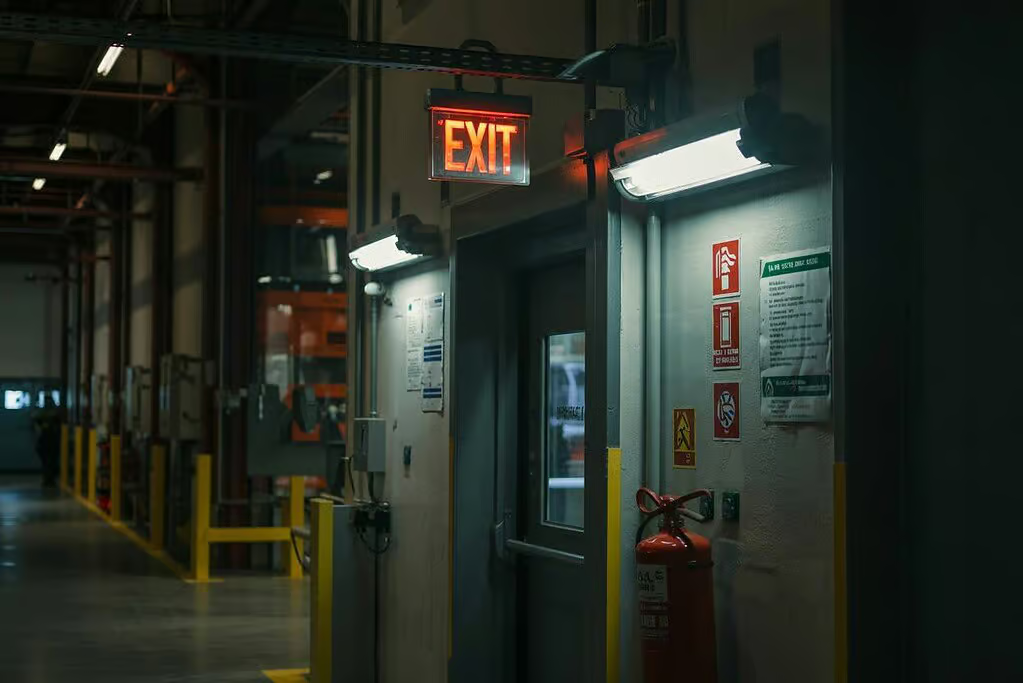
Let’s Break Down the Key Requirements:
1. Exit Routes and Stairways
Under 29 CFR 1910.37(b), OSHA mandates that exit routes must be permanently illuminated to a minimum of 1 foot-candle (10.8 lux) at floor level. Stairways, often the most hazardous areas during an evacuation, require consistent lighting to prevent slips and falls in high-stress conditions.
2. Emergency Egress and Evacuation Pathway
In a crisis, visibility can mean the difference between safety and harm. OSHA requires that all emergency exits and pathways be clearly marked and adequately lit, even during a blackout. This ensures that workers can evacuate quickly and without confusion.
3. Backup Power and Emergency Lighting
Emergency lighting must remain operational even if the main power supply fails. OSHA expects facilities, especially those in high-risk industries, to install battery-powered or generator-supported lighting systems. These systems should automatically activate and provide illumination for at least 90 minutes, aligning with general life safety codes and best practices.
Ensuring Compliance with OSHA Lighting Standards
Ensuring compliance with OSHA lighting standards takes more than simply turning on the lights. It requires planning, accurate measurement, and ongoing maintenance to provide a safe and productive workplace.
1. Conduct a Workplace Lighting Assessment
Begin by walking through your facility and evaluating lighting conditions in each work zone. Pay special attention to areas where precision tasks are performed or where hazards exist. Don’t overlook stairwells, emergency exits, or dim corners; these can easily fall below OSHA’s visibility thresholds.
2. Use Light Meters to Measure Illumination Levels
You can’t manage what you don’t measure. Use lux or foot-candle meters to assess lighting intensity. Since OSHA standards are typically specified in foot-candles (e.g., 5 foot-candles for general areas, 10+ for more detailed tasks per 29 CFR 1910.22), these meters are essential tools for compliance.
3. Maintain and Inspect Lighting Systems Regularly
Proper lighting today doesn’t guarantee compliance tomorrow. Schedule regular inspections to identify flickering, burned-out bulbs, or dust-covered fixtures that reduce brightness. Preventive maintenance, like replacing lamps before failure and cleaning lenses, ensures continued compliance and safety.
4. Consult Safety Experts for Audits and Recommendations
If you’re unsure about your lighting setup or want added assurance, consider hiring a certified safety consultant. They can conduct formal audits, identify high-risk areas, and offer solutions to align your workplace with OSHA standards, often preventing costly violations.
Common Misconceptions About OSHA Lighting Standards
1. Lighting vs. Lightning: What’s the Difference?
When people refer to “OSHA lighting standards,” they’re talking about workplace illumination, how bright areas like stairwells or warehouses should be. However, it’s often mistaken for lightning safety during storms. OSHA’s lighting rules involve foot-candles and visibility, not weather.
So In Short:
- OSHA Lighting Standards = Safe visibility and adequate brightness.
- OSHA Lightning Concerns = Storm-related hazards and prevention in outdoor or high-risk jobs.
2. Does OSHA Cover Lightning Hazards?
Yes, but not under “lighting” rules. OSHA addresses lightning safety under the General Duty Clause for outdoor industries like construction and utilities. If there’s thunder in the area, work should pause to avoid strike hazards.
3. Lightning Protection in High-Risk Sites
In high-risk environments, such as communication towers or chemical plants, lightning protection systems may be required. OSHA expects employers to mitigate any serious strike-related risks under broader safety regulations.
Best Practices Beyond OSHA Lighting Guidelines
Meeting OSHA’s lighting requirements is essential, but smart businesses go further to enhance safety, efficiency, and worker well-being.
1. Upgrade to Energy-Efficient LEDs
According to the U.S. Department of Energy, LED lighting uses 75% less energy and lasts 25 times longer than incandescent bulbs, while providing more consistent brightness.
2. Use Motion Sensors and Smart Controls
Lighting unoccupied areas wastes energy. Motion sensors turn lights on only when needed, ideal for storage areas or hallways. Smart controls can also adjust brightness based on daylight or time, reducing costs without compromising safety.
3. Prioritize Comfort and Visual Ergonomics
OSHA compliance doesn’t always mean optimal comfort. Poor lighting can cause eye strain or glare. Improve visual ergonomics by using balanced light, soft contrasts, and task-specific lighting to support both focus and health.
4. Align with IES and LEED Standards
These offer expert-backed benchmarks on illumination and energy efficiency. Over 80% of Fortune 500 companies now include IES/LEED recommendations in new facility designs to reduce operational costs and improve safety metrics.
FAQs
Conclusion
Lighting might not be the first thing that comes to mind when you think about workplace safety, but it plays a huge role. OSHA sets the baseline with clear standards to prevent accidents, improve visibility, and keep workers protected across all types of environments.
Businesses that improve lighting have reported a 40% reduction in workplace injuries over the past five years, according to industry safety audits.
From warehouses to medical rooms, and from emergency exits to industrial sites, the right lighting isn’t optional; it’s essential. But smart companies don’t stop at just being “OSHA compliant.” They invest in modern lighting solutions, prioritize employee comfort, and utilize technology such as motion sensors and LEDs to create better, safer spaces.